
Show & Tell

Two 2014 Striped Ghost Tessera corn snakes.
Show & Tell
Two 2014 Striped Ghost Tessera corn snakes.
Show & Tell

Three 2014 Pied-sided (p/s) Bloodred Tesseras. Not sure exactly how the lateral white patches will render through maturity, but I don’t think these will be ugly adults? Bonus Pic . . . .
Show & Tell

In our attempts to modify Sunglow Motley Corns for deepest coloration via selective-breeding, we strayed slightly from the orderly dorsal pattern for which Sunglow Motleys are largely famous. This year, we are back on track with great orderly Motley pattern AND the deeper colors that make Sunglow Motleys so visually striking. These postpartum Sun Motleys demonstrate perhaps 1/3 of the red/orange color-saturation they will exhibit as adults. They are five DAYs-old in the above image.
Show & Tell
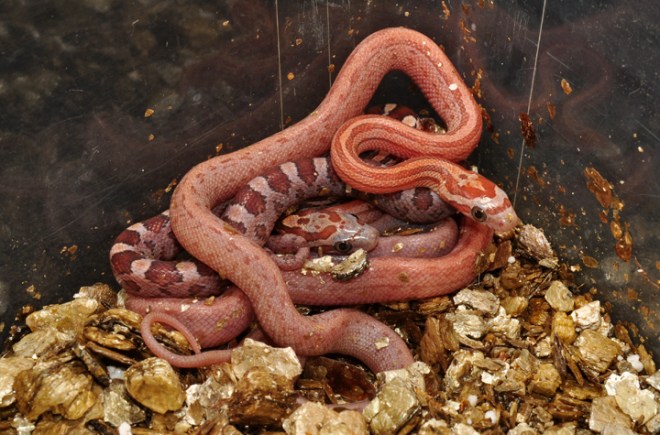
Most of our Terrazzo stock is zero-generations away from the original founding stock found on a Florida Key (island). Therefore, most of our adult stock has the classic overall tan coloration with darker tan/brown markings (vs. red in both color zones in most JMG Terrazzos). The original target look for the Terrazzos (formerly called Granite Corns) was to have the least amount of striping, leaving mostly “tracks” of the darker color, not unlike the freckled pattern common to most Granite Stone. More than half of this Terrazzo lacks organized striping, making it closer to the target of a stripe-less corn with modest freckling. . . .
Show & Tell

The red corns are Ultramel Bloodreds and the striped one is a Terrazzo.
Show & Tell

Several different Striped Tesseras; Anery, Common, Hypo, Ghost, a regular Tessera and an Extreme Blizzard. I know what you’re thinking; “why alluvasudden is there an EXTREME version of so many morphs, Don?”. This is the first year I’ll be offering Blizzards like this one – that show almost no markings because their parents are patternless and completely devoid of yellow. Will they mature to be yellow-less adults? I don’t know, but they are the best Blizzards I’ve ever seen so I’m going to market them for what I believe they will mature to be what most corn keepers want; pattern-less and color-less Blizzards. S . . . .
SHOW & TELL

Two angles of the same 2014 hatchling corn snake. Not rare in Anery-type Bloodred mutants, the ventro-lateral white on neonates usually changes to gray with maturity. This degree of lateral white on non-Anery-type Bloodreds often changes to red with maturity, but since this is not an Anery, we’ll have to wait to find out if it will stay white or change to the color that matches this morph. When this snake sheds next week, I’ll find out if it’s an Anery. BTW, if it turns out to be an Anery, it is the only one in three years of breeding its parents.
SHOW & TELL

2014 Striped Anery Tessera corn snake. The bluish tinge in the white stripe zones suggests that it could be both Anery & Charcoal which is entirely possible in the genome of its parents. If it were even bluer I’d say it IS a Charcoal Striped Tessera, but in this family, the Charcoals almost always have much deeper blue between striped pattern zones.
SHOW & TELL

Update on the Palmetto corn snake mutation.
I was surprised to see the above large-eyed Palmetto that hatched last week. I had wondered how we got so lucky to have a leucistic mutation in corns without seeing the bug-eyed specimens, which are common in other leucistic serpent mutants. History on bug-eyed leucistic snakes. . . .
SHOW & TELL:

The first Pied-sided (aka: p/s) Bloodred corn of our 2014 season just hours after emergence from its egg. All the faintly colored body zones seen here will be shockingly red-saturated at maturity, rendering a beautiful corn with stark white sides just below a mostly red pattern zone running down the back. Few of the high-white-expression individuals will be produced at SMR this year.
